What’s Next?

The other week I took down my Dark Ocean exhibition at Xchanges Gallery.

darkocean-56I am thankful for everyone who came to the opening and to the gallery while I was there. Over three weeks I met many interesting people: travelers, art students, gallery workers, volunteers, fishermen, scientists, artists, poets and thinkers. A gallery space is the perfect setting for starting conversations about art, daily life, science, whales and discovering new ways of looking at the world. I feel energized from the stories people told me about their own encounters with whales and listening to interesting facts that I didn’t know before.darkocean-23

For instance, I learned orcas can use a hunting technique for salmon where they swim in a “<” shape up a channel to funnel the fish into their body-net. Then they take turns switching out from the outside to swimming through the centre to catch a fish. They swop positions back and forth to create a community-cooperative dinner!

I was very interested in how people read my “Pod” installation. The mass of thousands of tiny, black pyramids took shapes in peoples’ minds that I couldn’t have guessed and I was so thrilled to discover! A cloud of krill gathering near the surface, a bait ball of fish, a swarm, an explosion, an info graphic of the ocean’s depths, way points on a chart, etc!

darkocean-9

While I have had an incredible month at the gallery, I felt like I was on hold. The time for making was on pause and I now had time to reflect on my work, listen to what other people saw in it and get back into my researching. I was asked many times, “So… what’s next?”. I wasn’t really sure what to say. While I know I will be making art about the ocean my whole life,  I didn’t feel ready to answer the “what”.

As I began taking down the work at the end of the show I realized that now I can get back to experimenting and try to find new art-solutions for the information I have been reading about. Now is the time for testing and trying and making!

For images of the exhibition, click here.
 

Something in not knowing

As a child I loved to get library books that looked at the world through cross-sections and comparison scales. A cross section showing the different levels of the ocean ranging from the light-active Photic Zone to the deep Abyssal Zone. Or the ever popular illustration comparing a blue whale to the weight of 40 elephants and the length of three school buses. These images are powerful and effective… but not accurate when expressing the raw majesty of a whale or the absence of human exploration at the bottom of the sea.

After our exposure to these images, there can be an underwhelming feeling about seeing the real thing. In fact very little of a whale is often seen from the surface. Sometimes just a tiny, dark blur or a cloud of mist. Last year I saw a mother whale with a young one: a large explosion of mist followed by a small puff of mist. I pointed this pair out to some others on the beach. The people smiled at me and nodded, faking interest and then left at the first opportunity. The very fact that whales often glide by in an understated manner (these whales never make the news), is the very reason that seems to pull me in. It is like an Alfred Hitchcock thriller: where the suspense is built around the not knowing and not seeing. A shadow cast on a whale is all we need to have our attention completely gripped and our imagination activated. It is the same with whales. It is incredibly poetic that the largest creatures on earth often pass mostly unseen except for their breath.

Cetology

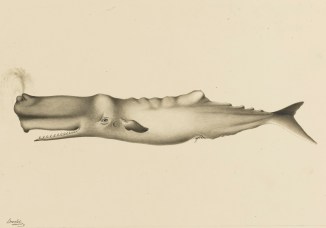
127L13401_6W2MT.jpgI stumbled across this amazing illustration by Louis Claude de Saulces de Freycinet while searching early scientific whale drawings. This creature seems so alien and monster-like. It is incredible to realize that Louis Claude de Saulces de Freycinet was drawing a Sperm Whale! I guess there actually are a lot of similarities; the broad head, the wrinkly skin, the bumps along it’s spine. Basically everything that could be seen from the top of the water is relatively accurate… and everything below the waterline looks like it has been “filled in”. What a great example of imagination paired with reality!


Studio Studies

Currently I am working on preparing surfaces to paint on, which takes a long time and patience…. which means….it’s research time again!

So I am back at the library, online and in books discovering more reasons why cetaceans are the most incredible creatures in the world! I love these images that I found online! There is so much mystery to these animals that only give you a little to go on at a time! The top photo is of a beluga, the bottom left is a white humpback, and the right one is a narwhal. So much diversity and grace…. I can’t wait to start painting again!

Studio Blog

This painting below is in progress. Lately I have been contemplating the possibility of the whale’s silhouette to become a land form. In fact… the whale is a form of land. Let me explain. I recently was reading about a creature that lives on whales and uses them as a stand in for an inter-tidal zonethe barnacle. Because whales breath air they must continually  surface, functioning, to the barnacle, like a rock at low tide.