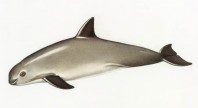
 A couple months ago I had to opportunity to become involved with a show that will be opening at the end of April in the Robert Bateman Centre. For the show, called Endangered Species — The Next Migration, the artists were asked to make art relating to an endangered animal from a provided list. So many of these animals I have never heard of before! I chose the Vaquita, a porpoise that lives exclusively in a small, northern section of the Sea of Cortes. Porpoises usually live in cold water, but this species lives in warm water and uses their overly large dorsal fin to disperse excess heat. They are also the smallest in the porpoise family, reaching a length of only five feet. These mammals have distinctly dark patches around their eyes and their mouth, with a streak leading from their lower jaw to their pectoral fins. Only discovered in 1958, it is estimated that there are less than 100 Vaquitas alive today. This week I left my pieces with one of the organizers of the exhibition. I am really looking forward to seeing this show and being introduced to more animals I don’t know (and the artists too of course).
Level Up

This week the Vancouver Island School of Art hosted Level Up, a painting exhibition for the second and third year students. I had the pleasure of not only being part of the show, but also to be involved with the curatorial team that got to hang the work. This exhibition turned out really well and the quality of everyone’s work really showed! It is so nice to look at my work on a clean white wall.
Studio Blog


This painting below is in progress. Lately I have been contemplating the possibility of the whale’s silhouette to become a land form. In fact… the whale is a form of land. Let me explain. I recently was reading about a creature that lives on whales and uses them as a stand in for an inter-tidal zone—the barnacle. Because whales breath air they must continually surface, functioning, to the barnacle, like a rock at low tide.
 Natasha van Netten