Interview with Whale Listening Researcher Leticiaà Legat

As many of you know I am interested in using art to build connections and help make science more accessible (specifically marine sciences). Often science and art can feel worlds apart, but at the heart of these two ways of thinking is very often the same motivator: nature.
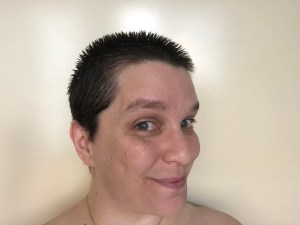
Leticiaà LegatA few weeks ago I had the unexpected pleasure of meeting Whale-Listener-and-Marine-Bio-Art-ologist Leticiaà Legat through Instagram. It is nice to know that you can still meet people and stay connected while maintaining physical distance. But when the other person lives in Brazil, it’s really the easiest and best way to meet anyways. After numerous messages and lengthy e-mails back and forth I quickly realized that Leticiaà is someone that you should meet as well. I asked her if she would mind my interviewing her on my blog and she has graciously agreed to share some of her experiences, thoughts and photos with you and I.


Natasha: Leticiaà, thank you for being so willing to share with us! What is it about whales that has drawn you to study them? Can you tell us a little about your background and education history?

Leticiaà: First of all, thank you for having me, and for your kind words! I’ve loved animals (and the sea) since I can remember, and by the time I was 6 I knew I wanted to be a Biologist. Whales entered the game a few years later. My brother was driving me to school one day, and telling me some killer whale tales he’d recently learnt. I grew instantly obsessed. Back then, the internet was not a thing (ha!), but with each new little scrap of info I slowly added together, the fascination only grew. Particularly in regards to their behavior and social structure. That holds true until today! So by age 10 began my dream of being a killer whale behavior researcher, which I’m so incredibly grateful I eventually got to do! The love for animal behavior and acoustics eventually grew bigger, and spread towards a huge range of taxa. Nowadays I’d likely be happy studying any cool vocalizing creature.

Leticiaà Legat doing field work

Leticiaà Legat doing field work

Background and education wise, I have a double bachelor in Biology, an MSc in Oceanography (analyzing contaminant levels in dolphin tissues), and was half way through my PhD when a whole lot of life happened. I am now getting slowly back at it, but have transferred to an MPhil instead. During and after graduating (some 14 years ago) I have worked with bird behavior; coordinated behavioral research in a big marine mammal project in Northeast Brazil, which also included collaborating with, and helping local fishermen and kids understand whales better; taught undergraduate university courses; had the pleasure to be an intern at a Brazilian Oceanographic museum; a visiting researcher at the Vancouver Aquarium marine mammal research lab (where I discovered my love for Bioacoustics); and did a few more internships and volunteering, in Brazil and abroad. I’m currently writing up my postgrad research on whale acoustic behavior. More specifically, Icelandic killer whales and North Pacific humpback whales feeding calls.

Natasha: What is this research about?

Leticiaà:  I looked in detail into two incredibly similar calls that Icelandic killer whales and North Pacific humpback whales use. They are both loud, low frequency, long calls; and are used only in one behavioral context: while feeding on herring schools. So, we have two very different cetacean species (fairly distantly related in evolutionary terms), which live in different oceans, using a very similar call, for the exact same purpose. They haven’t heard the call from one another and copied it, nor do they have similar acoustic repertoires to begin with. In fact, the calls’ frequencies are out of the optimal hearing range of killer whales, meaning is too low for them to efficiently communicate in.
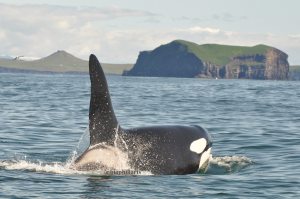
Killer whale off Vestmannaeyjar, Iceland. Photo credit Leticiaà Legat

Killer whale off Vestmannaeyjar, Iceland. Photo credit: Leticiaà Legat. This photo was taken under research license, with a tele-lens and cropped. Please respect all guidelines when in the presence of whales.

This is what we call convergent evolution; a process in which not closely related organisms independently evolve a similar trait, to adapt to similar ecological niches. Meaning the two calls evolved twice (once in each cetacean population), to serve the same end: help in herring capture. These calls have been known and independently studied for a few decades, but never looked into together/ comparatively. By statistical analyses, I could for the first time compare both calls, and show just how similar they are (strikingly so!). The calls seem to be used to manipulate the schooling behavior of herring groups, which (research shows) groups tighter when the calls are emitted. This in turn should make it easier for both bubble-netting humpbacks to trap, and tail slapping killer whales to hit the prey before consuming it.


Break between land-based observation sessions in Cetacealabe, Gil Island, BC. Photo credit Sam Rose Philips

Break between land-based observation sessions in Cetacealabe, Gil Island, BC. Photo credit: Sam Rose Philips

Which’s really interesting, since the herring schooling behavior is in itself, originally, an anti-predator strategy (now being exploited by predators!). Interestingly too, the calls frequency is also in the resonance frequency of the herring swim bladder, which could have several implications, and be precisely why this frequency was evolutionarily selected. The call also seems to be spreading, at least in the humpback population, meaning other whales are learning to use it too. Learning has been previously described for several cetacean species, including the ones I’m studying, and this component adds a whole other layer of interest regarding cognition (learning, innovating, problem solving…), and social structure (who hangs out with whom, in which contexts, for how long, etc.). In other words, there’s still lots of missing pieces in this puzzle, including the ones I was to look into before the aforementioned “lot of life” happened… But that’s how science happens, cooperatively. Adding new research (pieces) together with previous data, until we get to see the whole picture. Here’s hoping I get to dive back into it someday soon!

Natasha: Do you have a favourite whale species? And can you tell us why?

Leticiaà: I think I’ll stick with killer whales here (even though they’re big dolphins). Their cognitive abilities (the learning, problem solving, innovating thing again) are very  impressive. And I find it fascinating that whilst having only one recognized species worldwide (so far, despite genetic evidence suggesting otherwise), there are SO many different types, with such different diets, specializations, behaviors, complex social structures, morphology, acoustic repertoires… So many different cultures altogether, even when sharing the same habitat. And it doesn’t hurt that they are beautiful creatures to look at, and sound pretty good as well. That being said, I dream of one day seeing a blue whale, and have a special fondness towards minke whales (so overlooked!), long finned pilot whales, and southern right whale dolphins.

Natasha: What role does art have in your life? Do you find that your research informs the art you create? What type of art do you enjoy making?

Leticiaà: Art has been part of my life since I was a kid. I have experimented with several media over the years, but eventually abandoned all (but nature photography) for a really long time. This was before I connected the arts and science dots in my head, you see. I continued to adore, admire, and respect art.
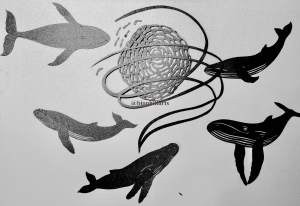
Bubble netting papercut by Leticiaà Legat

Bubble netting papercut by Leticiaà Legat

But somehow started thinking of all the art I did as time wasting hobbies (even scientific drawing!), and forgot how much nourishment and balance I get out of creating. Of how truly powerful it can be, including for research communication. It took me getting incredibly ill long term, to very recently relearn that, and see how much I need art in my life. That also helped me realize that art and science are simply different ways of investigating nature, and sharing my love for it. And that’s how Biopliliarts was born. I’ve only just started tending to it properly, so here’s hoping it’ll grow beautiful and strong! I do mostly nature inspired art, love to experiment with different media, and aim to share some of my knowledge through it (or at least in the accompanying texts, as I also love some whimsy…).

Fun, bizarre, possibly too disturbing fact: in a way, my research not only informs my art (I have a gazillion whale photos, plus a few animal design ideas floating in my mind at any given time), but it actually has given me the skills required to do some of it… During my PhD I discovered paper cutting art, which in time became my favorite media. You basically use craft knives or surgical scalpels (I use scalpel blades in craft knives, for comfort) to cut paper into patterns, revealing your chosen design. I was instantly fairly good at it, for the weirdest reason: dolphin necropsy skills. During my internship at the oceanographic museum, and later during my MSc, I did countless necropsies and tissue collection on dolphins that had washed up dead (more commonly drowned while entangled in fishing nets…). It’s a really sad reality. But I’ve also always appreciated that with marine mammals, contrary to most other Zoology subjects, we never kill animals for collections or analyses (something I could never do). We only collect either very tiny dart biopsies samples, or sample already dead animals.

Natasha: Can you give a few examples of some of the places that you have traveled to because of your love of whales?

Leticiaà: I’ll start by saying that whales have great taste in places! haha Having grown up over 1500km from the ocean, as soon as I finished my undergraduate degree I started chasing whales around. First in the beautiful (and unbearably hot) Northeast of Brazil, then the Southeast of the country (Santa Catarina – thoroughly worth visiting, and Rio – not really a fan, but also worth visiting), and then I moved to British Columbia (enough said!). I lived in the English countryside (of all places!) for the past 6 years. I chose to move there to study under my brilliant supervisor. Meanwhile, I did field research in British Columbia and Iceland, and brought the data home for analyses. And I’ve visited Scotland often, for courses and such. I have also been to both Washington DC (what?) and Denmark (with a stop at the Faroe Islands on the way!) for Bioacoustics graduate summer schools. Finally, marine mammal researchers have a way of choosing beautiful places for conferences. I’ve been to meetings in Nova Scotia, San Francisco, South of England, Scotland, a different place in Denmark… Ah, and of course, I’ve been to Patagonia! That was my dream destination since I discovered the local killer whales as a 10 yo, and I got to visit (and see them!) ten years later, before even becoming a Biologist.

Natasha: What is it about whales that you find the most interesting? 

Leticiaà: I’m mainly interested in behavior and acoustics, particularly predator-prey dynamics (like the feeding call research for example), and how novel behaviors or calls spread through populations (or across populations at times!). Sound is the most important tool cetaceans use to perceive their environment, navigate, communicate, find prey, find mates, and in some cases, manipulate prey behavior. So there’s a whole lot we can learn simply by listening. And (particularly with increasing levels of anthropogenic noise) it’s very important that we do so. There’s a lot we don’t know yet. And since cetaceans spend most of the time entirely submersed, researchers are at a huge disadvantage when studying their behavior in comparison to, say, wild pig researchers, who can see their study animals most of the time. With increasingly fancy technology though, the underwater world is becoming more and more accessible to us.

Natasha: Can you tell us about your favourite whale encounter or experience?

Humpback whales bubble-net feeding in British Columbia, Canada. Photo credit Leticiaà Legat

Humpback whales bubble-net feeding in British Columbia, Canada. Photo credit: Leticiaà Legat. This photo was taken from shore with a tele-lens and cropped. Please respect all guidelines when in the presence of whales.

Leticiaà: I think most of them happened in Iceland. The killer whale juveniles and calves spent my first field season there chasing the hydrophone array we towed behind our boat (like a 60m huge hose, filled with sound recording equipment). It was a lot of fun to watch them investigating it, and I got fantastic recordings from it. Until one day, after they`d been particularly relentless in the chase, I pulled the array back on board at the end of the day, to discover they had chewed the end bit off! I still don’t believe it and I was there… After that day they completely lost interest though. The Icelandic pilot whale encounters were fascinating too, and are possibly my favorite thing. They arrive in several small organized groups of over a hundred individuals in total. Vocalizing non-stop, with perfectly coordinated movements, they mob the killer whales, charging at them at full speed, and chasing them out of the area. It’s fascinating and terrifying to watch. We started calling them pirate whales…

In Cetacealab, Gil Island, BC (whose researchers generously made their long term data collection available for my analyses), we’d sleep lulled by whale breathing sounds, and watch several species from shore, sometimes swimming right under the lab’s observation balcony… It’s the best way to see (and study) whales when possible, really. Without interfering at all in their behavior.

Natasha: For someone who is interested in whales and would like to learn more (like myself), are there any recourses that you recommend?

Leticiaà: I know and trust the work of @oceanwise, @merssociety, @BCWhales, @soundsciencecollective, @icelandic.orcas, @centerforwhaleresearch, @alaska_whale_foundation, and @themarinedetective (the latter on marine life in general, not only whales), all on Instagram. I also recommend checking out the work of the Hebridean Whale and Dolphin Trust and of North Gulf Oceanic Society on Facebook. They all do research, outreach, and education, the sacred science tripod. There are plenty more great projects a google search away as well (yay internet!).

Books wise, I remember really enjoying reading Orca: The Whale Called Killer by Erich Hoyt and The Cultural Lives of Whales and Dolphins by Hal Whitehead and Luke Rendell. And if despite the use of specialist language you’re at all interested, nowadays it’s fairly easy to get hold of some scientific papers for free. You can either look for them on Google Scholar or Research Gate, a sort of “social media for scientists” type thing. Many researchers make their publications available there, and if not, most will also be happy to send you a copy if you get in touch via email (if they’re not crazy busy!).

Natasha: Finally, do you have any favourite whale related fun facts you can leave us with? 

Leticiaà: Yes!

  • Cetaceans are born tail first, a neat adaptation that means they won’t drown in case the birth takes a while.
  • Blue whales are the largest animals to have EVER lived on Earth. How cool is that? Calves can gain over 100kg a day in the first few months of life by nursing on their mother’s rich, fatty milk.
  • I’ve once listened to a recording of narwhal vocalizations, and no kidding, it sounded like the intro theme for The Addams Family.
  • The sound used for the dolphin in the infamous 90s movie “Flipper” was actually an altered kookaburra bird call!
  • Minke whales have a very particular, strong smell. They are often referred to as “stinky minkes” by researchers.

To learn more about Leticiaà’s art practice you can check out her Biophiliarts website by clicking here and follow her Instagram page by clicking here.

I would send a big thank you to Leticiaà for being so open and willing to share! It feels special to have a peek into the scientific world and learn about what is being studied. And it is always a pleasure to meet someone that also shares a love of sci-art (science-inspired art). Oh, how I love those papercuts! =)

Musings

What I have learned from residencies and traveling is that anything can happen, everything can change and it is beneficial to learn to adapt quickly. Stay flexible. This is something I find myself thinking of right now. Everything looks familiar outside… but I know it is also different. A change of routine… or a lack of routine. A fresh slate, as it were. And so here I find myself in my second-floor apartment at my kitchen-table-studio, trying to get my head around the strangeness of what is happening and trying to figure out how I fit into the picture and how I can adapt.

These past few weeks have been difficult ones for me, as I am sure they have also been for many of you navigating life right now. I am trying to remind myself that difficult doesn’t mean bad. Challenges are not bad. A change of routine is not bad. When life is smooth it’s easy to click into “default mode”, but when something upsets the expected flow I am reminded of the value in paying attention.

Especially when their are voids in life, things that are missing (like a job or a family member), it is important to be thankful. One of the countless things I am thankful for is art. It helps me to process, it gives me space to be quiet, and it settles my brain from working in high gear. To take time to stop thinking about life’s complications and slow down and concentrate on the tip of my pen and the line it is drawing is freeing. Strangely enough, I think when I am unaware I am thinking I think the most effectively (sorry if that doesn’t make sense). I encourage all of you to do something creative today–trust me, it’s not just for the “gifted” or the “artistically inclined”. It is about the journey after all, not the destination.

I have been loving my Picture By Post project! Through it I have had the opportunity to reconnect with friends and make new ones. It has been something fun and encouraging for me to focus on and I have enjoyed many walks down the road to the postbox with a happy stack of envelopes. It’s actually strange to think that during this time of distancing I’ve connected with way more people than I would have otherwise. I am grateful for the conversations, the connections and the lovely photos that people have sent me back through this project. The pictures have been posted all across Canada (from right here in Victoria all the way to Nova Scotia), the USA, England and even to Germany!  I would like to say thank you to everyone who has participated so far (and if you would like to have a Picture By Post mailed to yourself or a friend, please click here to contact me).

Thank you @chirp2lou for bringing your Pictures By Post to the beach and sharing these lovely photos!

I would love to hear what you are doing to deal with all the changes right now. How are you adapting? Have you tried something new? Or maybe picked up an old project to finish?

Stay strong. Be encouraged. Ask for help if you need it. We are in this together. =)

Picture by Post Project

A lot of things are up in the air and changing these days. I am finding myself looking forward to more “time off” (AKA studio time) than I was expecting. As a way to beet the social distancing blues I came up with the following project… Picture by Post! 

Would you like to receive a mystery artwork in the mail?
I have recently been inspired to start a new project… Picture by Post! Combining two things I love – mail & art. For $10 I will create an original 5″x7″ drawing or painting and mail it to you.

Why do it?
🔹 So you can look forward to receiving “fun” mail

🔹 Buy really affordable art

🔹Maintain social distance by receiving through the post

🔹Anticipate a surprise!

🔹Support local art 👍

You can expect any of the following:

  • A watercolour 🖌
  • Pen & ink drawing 🖋
  • Graphite drawing ✏
  • Gouache painting 🖌
  • Imaginary sea creatures
  • Whale drawings
  • Ocean inspired themes
  • Or whatever I feel like creating in the moment!

How to participate:

  • Contact me to request a mystery artwork and send me your mailing address (or the address of a friend!)
  • Payment via e-transfer
  • Sit back and look forward to collecting your artwork from your very own mail box!

Picture by Post poster

Under observation in the studio

As most of you know, my work revolves around finding connections between art and science and looking for ways express scientific ideas visually through art. My husband has been encouraging me for a while to look at my work under a microscope as another way to merge these two practices. I am excited to share with you that this past weekend we were able to finally explore this idea. And wow–it takes observation to a whole different level. Looking so closely that I’m not even sure what I’m looking at any more. It is an interesting reminder that all art is abstract because its not actually an image that you are looking at, but strokes of pigment attached to the fibres of your drawing paper. The picture below shows a tiny close up of part of a salt formation on one of my seawater drawings. I love the circle around the image from the microscope lens. A circle is such an interesting shape because it represents both the infinitely small and the infinitely massive–like a cell or a planet.

Drawing under the microscope

Blinded by Whiteness

Saying Goodbye

Saying goodbye to new friends

Yesterday I found myself sitting in the shuttle bus looking out the window at whiteness. I turned to see my husband wipe the condensation off his side of the window to see better, but it remained as it was before. White. As I sat blindly gazing out at this alien world of white rushing past my window I was reminded of our arrival a month ago. It was snowing heavily and it was difficult to distinguish anything apart from swirling snow mounds of snow and blowing snow. This journey felt like being blindfolded and brought to a hidden and secret place so you don’t know how you got there. But instead of being blindfolded by darkness, we were blinded by whiteness. It’s about a half hour drive from Skagaströnd to the town of Blönduós, where the main bus stops that goes to and from Reykjavik. I have absolutely no clue what the landscape looks like between these two places. Not on the way there. Not on the way back. Somehow this makes me strangely happy.

It has been a full last week at the residency. This past Sunday was the January 2020 Opid Hus (Open House). It was a wonderful event and many local people came out for it. I had some lovely conversations with people about the work and about living in northern Iceland. One gentleman asked me an interesting question, “But what is it about whales that make people connect with them? Why not other animals? People don’t feel the same way about fish that they do about whales.” I guess this isn’t really something that I have thought much about before. Why whales? I would be interested to hear your thoughts on this question. I think there are many answers, but I think that people are drawn to things we can empathise with, things we reflect ourselves into, common struggles and successes, etc. Whales are mammals, like us. Whales breath air, like us. They generally have one baby at a time and their life cycles are very similar to human life cycles. They are intelligent and learn, they pass along information and have strong family bonds. Whales grieve their losses and seek to develop relational bonds. I think it is going to be different for every person that answers this question. But for me, it also has to do with knowing about something. They more I know, the more I connect. This is why I create art about these amazing animals. Sorry for the tangent. The Open House was lovely! I have some images below of some of the other artist’s in their spaces and my studio space at the end.

Images from the Opid Hus

Drawing class 

I was also asked if I would like to give a drawing class to a girl from the town. I was happy to be asked and enjoyed putting together some drawing projects. One of the artists at the residency came with her daughter and so I extended the invite to her as well. It was such an enjoyable afternoon. The young women were so dedicated to their art and it was a pleasure to be creative together. This was a real highlight for me and I am I had the opportunity to do this.

Natasha leading a drawing class

I traveled back south to Reykjavik with 6 of the other residents and 1 resident traveled north. We said good bye at the Blönduós bus stop and headed in opposite directions. Artist Katya Kan (Kazakhstan) traveled to Akureyri where she and I have an exhibition at the Art Ak Gallery this weekend! =) The perfect way to end my time here in Iceland.

BioPol, Lumpfish and Clouds

I have been in Skagastrond for three weeks now at the Nes Residency. I feel like my projects are starting to be picking up momentum. Since my purpous on this residency is to explore I have been allowing myself to create whatever I had the urge to make. I have ended up with some very strange creations that were not nessicarily what I would call
“successes”. But I feel like it is sometime nessisary to create unnessisary things. Even when I know from the beginning that it is probably not going to turn into something interesting. In the studio everything becomes connected. One thing leads to another and another and so on. Sometimes your brain needs to let go of the pressure of trying to force out a “good” idea and just become engaged in a process. Any process. I find that very often that when my mind in engaged in this way it is able to wander and that is when I find inspiration for new projects. I have been trying to be conscious of this and allowing myself this space and freedom.

Studio work in progress

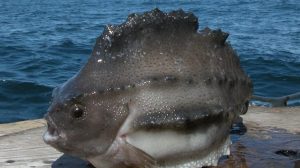
Another way to find creative inspiration is through research. Earlier this week I had the privilege to meet with Mr. Halldór Ólafsson, founder of BioPol, a marine biotechnology company here in Skagastrond. BioPol is involved with a variety of projects studying marine life that live in the water in Húnaflói Bay. Industry in Skagaströnd has always revolved around the sea, but over the last few decades fishery after fishery has had to close their doors. BioPol’s goal is to find new ways of creating sustainable industry through the sea. It was fascinating to be shown around the facilities. There is even an experimental kitchen–something between a scientific laboratory and a chef’s day dreamy clean kitchen. Halldór showed me around the different rooms of microscopes, people in lab coats and specimen containers. One research project that they are working on is trying to discover the lifespan of lumpfish (Cyclopterus lumpus). What? You’ve never heard of the lumpfish before? Don’t feel bad if you haven’t, I hadn’t either.

Lumpfish, image from icefishnews.com

Lumpfish, image from icefishnews.com

Female lumpfish are caught commercially for their roe which is sold as caviar. Actually a pelagic fish (living in the open sea), these fish come into the bay annually to spawn. The males arrive first and seek out the best place for a nest, often in kelp forests. Later the much larger females arrive and choose the most attractive partner and nest. She lays her eggs and heads back out to sea, leaving dad to fiercely guard the nest and helping to circulate oxygen-rich water over the eggs. BioPol is trying to discover how long these fish live. To do this they are using a well known fish-aging process: counting the annual rings laid down on otoliths–like counting growth rings on a tree. An otolith is essentially an ear bone of a fish–acting similarly to our inner ear as it is used for balance.

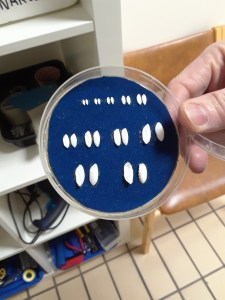
Cod Otoliths at the BioPol lab, Skagastrond

Cod Otoliths at BioPol

Depending on the species otoliths come in a broad range of shapes and sizes. In this image on the right Halldór is holding a range of specimens from cod. This labour-intensive work of counting otoliths is difficult when it comes to lumpfish as they have particularly difficult rings to distinguish between. It is absolutely fascinating! Thank you so much to BioPol and Halldór for allowing me to come and see what you are doing. =)

Nacreous Clouds

Nacreous Clouds

While we are on the topic of learning and discovery, I just wanted to share one more thing with you. Yesterday as the winds of the current storm were beginning to pick up we spotted a strangely glowing cloud in the sky (centre in the image above). I have seen this a few times already since coming to Iceland. It is a rare nacreous cloud, also known as an “iridescent cloud” or a “mother-of-pearl cloud”. The cloud turns into a rainbow of colours as light passes through frozen waterdropplets, skattering the light.


Photos of Skagaströnd

Here is a little peek at the little town of Skagaströnd. The town population is around 400. There is a church, a gas station and a grocery store, a gym, an outdoor heated pool and “hot pot” (hot tub), a bank, a pharmacy, and a post office and the residency. Usually the only people I see outside are kids walking back and forth from school, unless it is a rare calm and clear day and then the town starts to buzz with activity! The towns’ economy is largely centered around fishing (which has fluctuated throughout the centuries). An idyllic setting nestled along a natural harbour at the base of towering Spákonufell  (Prophetess Mountain). The mountain is dedicated to the first woman of Skagaströnd that lived here in the 10th century. Apparently she has left a treasure chest hidden by a spell somewhere on the mountain. 

Storm

I have been at the Nes Artist Residency now for almost two weeks. It is only now dawning on me how lucky we were to have good weather when we arrived. I feel like since our arrival there has only been a handful of “calm” days between stormfronts. The weather is constantly changing here. Being an isolated island located somewhere between two massive continents along the most northern edge of the Atlantic Ocean it isn’t a wonder why storm follows storm follows storm. The roads have been closed most days it seams, cutting Skagastrond off from the rest of the country. The snow comes down swirling, spinning and blowing past in a fury of white. Sometimes the storms are predicted a day or two in advance. Sometimes they just come.

Two days ago I arrived at the studio to enjoy one of these rare “calm” moments. I gathered my watercolour supplies and a stool and headed out to the edge of the breakwater to paint and watch sunrise turn the sky pinkish around 11am. By 2pm the sky was thick with white and gale force winds were slamming into whatever stood in their way. The houses here are built especially solid to withstand the wind and yet the wind tries her best to test them. Creating noises that sound like the house is loosing. The storm lasted for approximately 20 hours. Not once did the wind take a breather or the snow stop falling. Blizzarding conditions. A complete whiteout at times. But where did it all go? The snow was sure on a hurry to get somewhere, but maybe not here. Oh yes, there are massive piles of it scattered throughout the town (often finding the perfect location in the middle of a path), but I can only imagine that the majority of the snow is stuck fast against the side of a mountain somewhere. That day the weather hit, we were in the studio. Eventually we decided we either had to sleep in the studio or brave the weather outside. Without any snow or ice or head winds I am sure this journey should only take two minutes to walk between. It was a battle. Jackets pulled up, hats pulled down and with scarves securely fastened around our faces, the three of us stepped from the warmth of the studio and into the dark forces. My husband, the lovely French artist Sandrine and myself locked arms and headed home. “All for one and one for all!” (And yes, you would be right in supposing that the book I brought along with me is The Three Musketeers). What an exhilarating experience! We were thankful to be home, to make dinner and to be able to sleep in our own beds. Sandrine mentioned when we were in the kitchen that evening that it feels like we are in an igloo–the windows were plastered with snow!

The storm is over now and there is again a certain calm over the town (although the wind waves are still high). There is nothing quite like weather to make you really feel like you are in the present.

Modern Icelandic Whaling and Sweaters

It is hard not think about whaling while being in Iceland. I was doing some research yesterday and discovered that some of the whaling vessels that hunt minke whales stay at port in Hafnarfjordur, a 10 minute walk from where we stayed at our Airbnb. There are two commercial whaling companies here. One company hunts minke whale and one hunts the endangered fin whale. Minke whale is what you can buy in restaurants and in the grocery stores here (no, I will not be partaking) and fin whale is exported and sold to Japanese markets. This past year though there was a temporary, year-long pause on whaling in Iceland, but it is set to begin again in the spring. The pause came because of a lack of demand for the meat. I was surprised to discover that actually very few Icelanders enjoying eating whale meat and the biggest market are the tourists that come here. It is marketed as an exotic delicacy and a “must try” while visiting the country. It is hard to see why the whaling industry continues though when the income generated by whale watching companies is significantly higher than selling theme for meat (and is much more sustainable). While researching I came across this recent documentary called Hard to Port about the current whaling situation in Iceland. It is worth watching if you are interested in this topic.

But how do I process this….

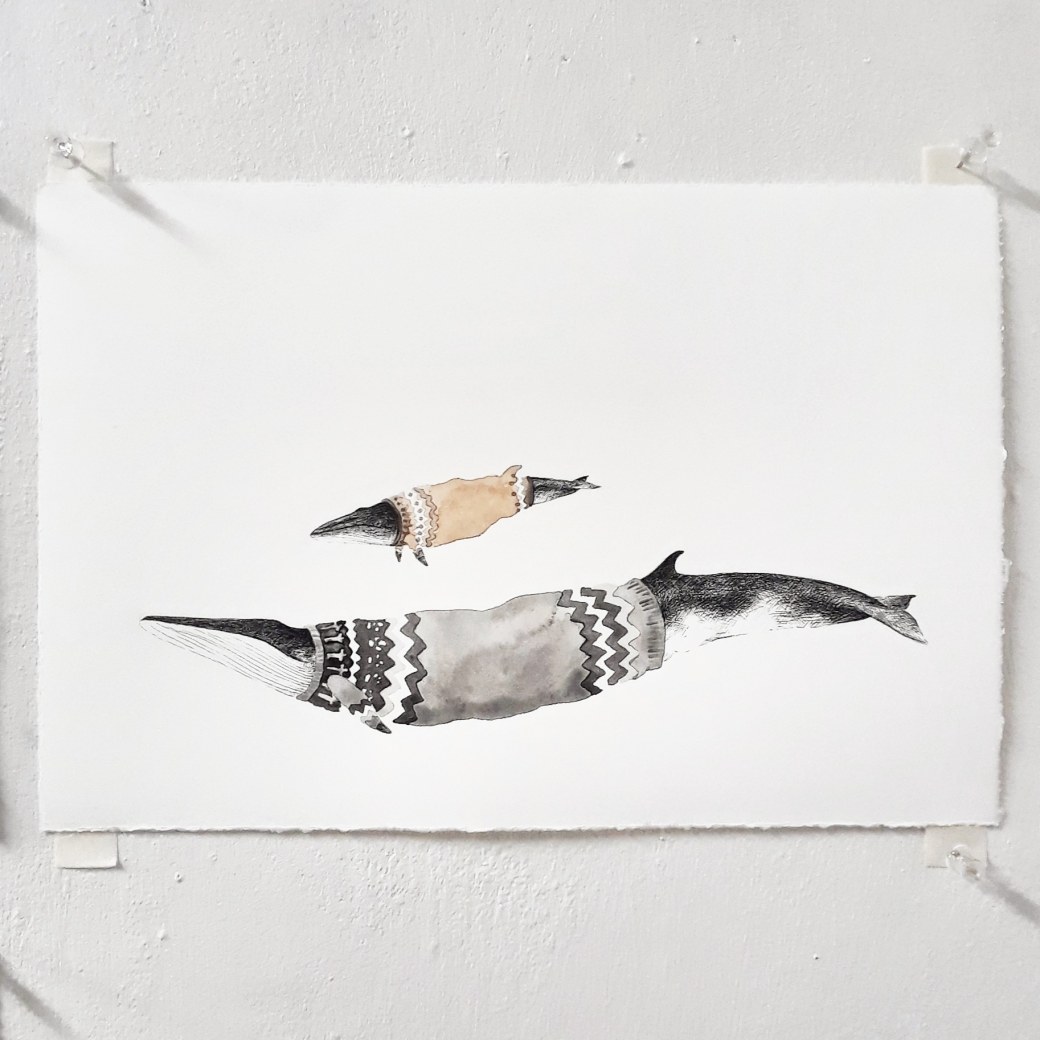
While listening to these documentaries I was thinking about a recent series I made this winter of whales in Christmas sweaters. I was speaking with a gentleman who was looking at them and he said something that stuck with me. By clothing these whales he felt like they were being cared for or nurtured. Forgive me if I am sounding sappy, but I love it when someone makes me a homemade gift like a hat or scarf. These gifts keep me warm on the outside as well as on the inside because I know they take a lot of time and care to make. So I created this small watercolour of a minke whale and a fin whale wearing iconic Icelandic sweaters. I am planning on making two more similar drawings. One for each of the three countries that still continue to practice commercial whaling (Iceland, Norway and Japan).

Whales wearing sweaters… huh… I think might possibly be my most political work yet.

Icelandic Whales in Lopapeysa

The upper whale in this drawing is a minke whale and the lower whales is a fin whale. Fin whales are still considered endangered. They are the second largest animal in existence (only loosing out on the champion title to the blue whale).  This drawing shows the size difference between the two species. 

8.5″ x 11″, ink and watercolour on rag paper 

NES Artist Residency January 2020 Group

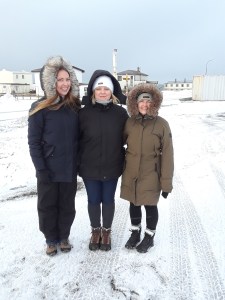
Today we gave artist talks as a group. It was amazing how different and interesting everyone’s practice is. I thought I would just quickly share this group photo. We are six artists and represent six different countries!

NES Artist Residency January 2020 Group Photo .jpg


Left to right: Sakari Heikka (Musician from Finland), Indigo Perry (writer from Australia), Sineád Bhreathnach-Cashell (visual artist from Ireland), Sandrine Elberg (photographer from France), Katya Kan (visual artist from Kazakhstan), Natasha van Netten (visual artist from Canada)